
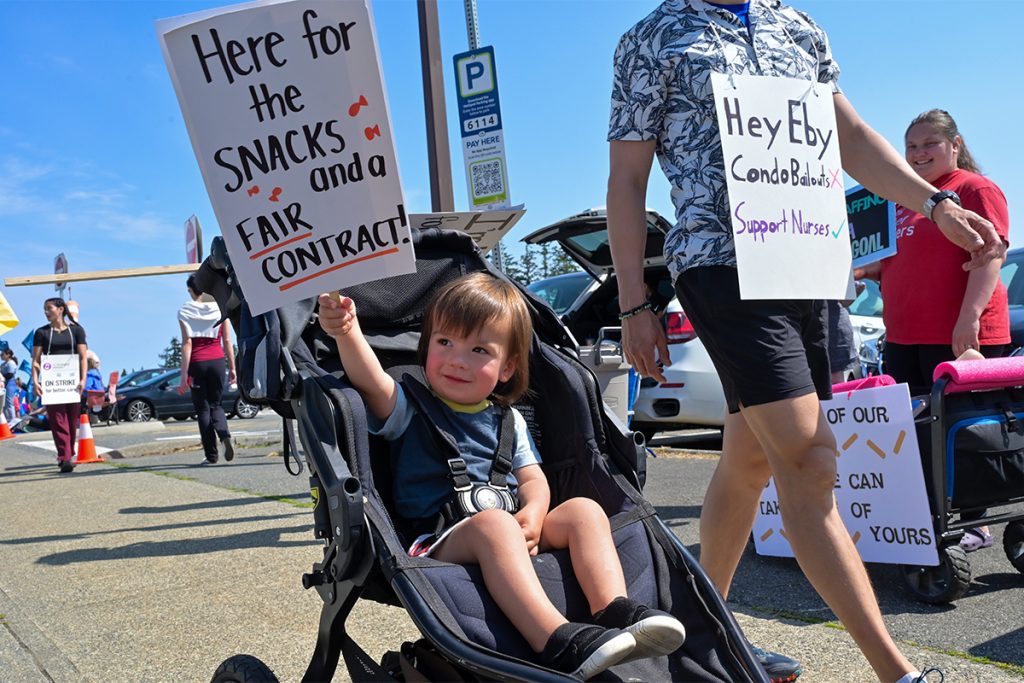
Nurses at Nanaimo General Hospital walked off the job early Monday morning as part of an escalating series of job actions that are part of a legal strike underway across the province.
This is the first nurses strike in the province since 1989.
As nurses walked the picket line in front of the Nanaimo hospital, they were joined by health-care workers from other unions including the Health Employees Union (HEU), Health Sciences Association the BC General Employees Union, and representatives from nursing unions from across Canada.
BC Nurses Union (BCNU) president Adriane Gear spoke to nurses on the Nanaimo hospital picket line.
“We’d rather be in there than out here,” she said, pointing at the hospital. “Our communities deserve to know that nurses care for them, and that we need you to also make sure that our voices are heard.”
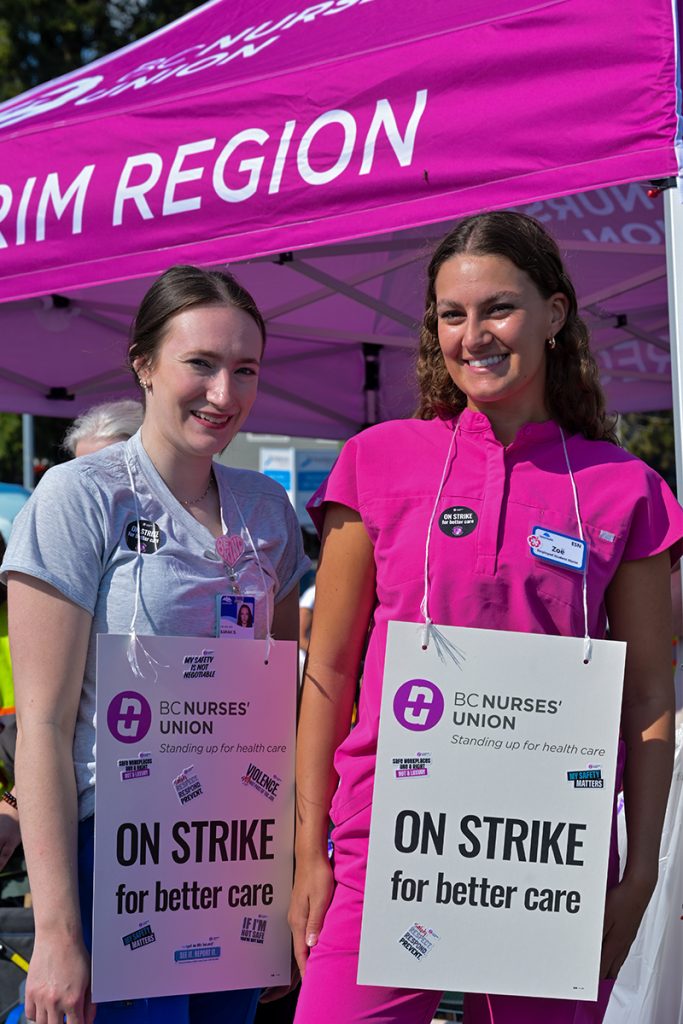
The nurses strike started on July 2 after nurses rejected a tentative agreement recommended by the union’s bargaining committee. Two thirds of nurses (67 per cent) in the province voted the agreement down.
The agreement included the same general wage increase as other public sector workers as well changes to benefits and long-term disability.
Nurses across B.C. are currently taking job action by refusing to perform non-nursing duties, a ban on non-essential overtime, and strikes at hospitals in Vancouver, Surrey, Nanaimo and Victoria.
During the hospital strikes, the union is responsible for ensuring that essential staffing levels are maintained.
Gear said that when there is not a job action nurses often work “far below essential service levels” to the point that it impacts patient safety.
Emergency rooms and urgent medical procedures, such as surgeries for cancer, remain operational during a strike but elective procedures and surgeries are cancelled.
The picket line at the Nanaimo Regional General Hospital will come down at 7:15 p.m on Tuesday, July 14, as a demonstration of good faith as mediation is underway, according to a nurses’ union spokesperson.
“We are entering mediation with cautious optimism,” Gear said.
Mediators appointed by government
On Friday, the B.C. government appointed long-time labour mediator Vince Ready and Amanda Rogers as special mediators in the labour dispute.
The special mediators will work with the nurses union and the Health Employees Association of B.C. for 10 days.
Minister of Labour Jennifer Whiteside — a former Health Employees Union secretary-business manager — made the appointment and a government news release said the province “remains committed to upholding the principles of B.C.’s labour laws, which recognize that collective agreements are best reached at the bargaining table.”
In a news release about the appointment of special mediators, the union said it would only be meaningful if it resulted in “significant movement” on issues that are important to striking nurses, such as staffing, safer workplaces, workloads and compensation.
After the rally at the Nanaimo hospital, Gear said she was flying to Vancouver to meet with the mediators.
An email from the Health Employers Association of BC to The Discourse said it was currently engaged in mediation with the Nurses Bargaining Association and “out of respect for the process, [it] will not be commenting further at this time.”
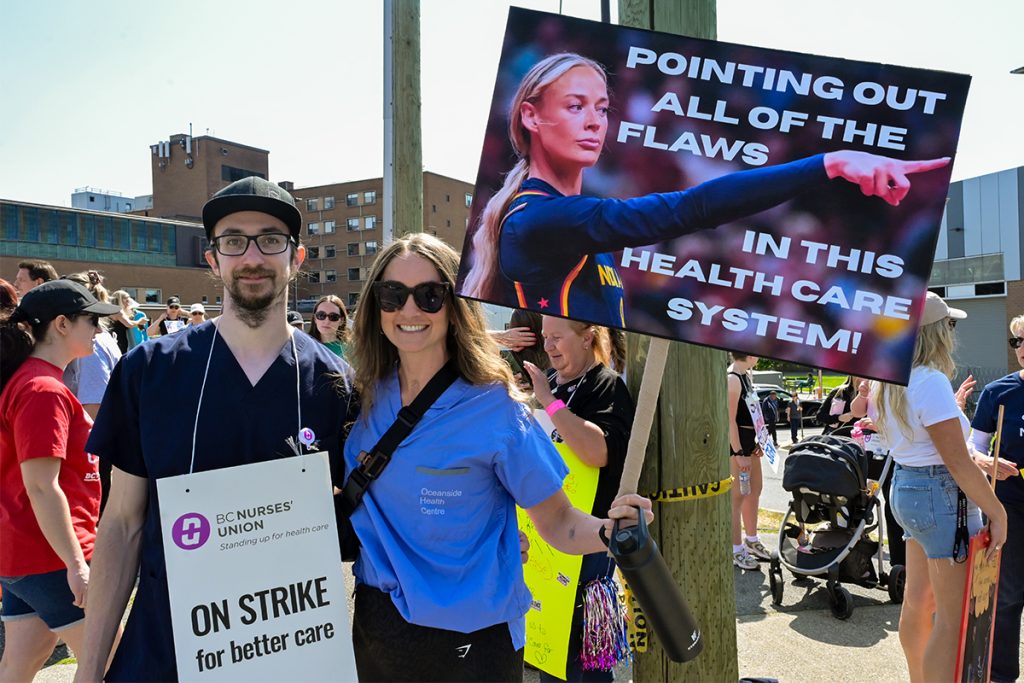
‘Deplorable’ working conditions in Nanaimo Regional General Hospital union leader says
Deidrie Knudson, the nurse’s union council member for the Pacific Rim region, told The Discourse working conditions at the Nanaimo Regional Hospital are so poor that newly recruited nurses at the hospital already want to leave.
“We have Tod Maffin, who’s been doing recruitment campaigns bringing international nurses onto the Island, and now we’re hearing from those nurses that have come here that the working conditions in the hospital are deplorable, and they’re trying to figure out how to get out of the hospital,” Knudson told The Discourse.
Knudson said nurses in the Nanaimo hospital are stretched thin and the hospital is running on nurses pulling overtime to provide patient care.
“We have massive overcrowding in our emergency department and our psychiatric emergency services, and there’s just not enough beds in the hospital to help support them,” she said.
Nurses are working short-staffed on a daily basis and are burning out, Knudson said.
“Nurses are tired,” she said. “There’s so much overtime that is being used to staff the system right now, and our nurses just need to have a break.”
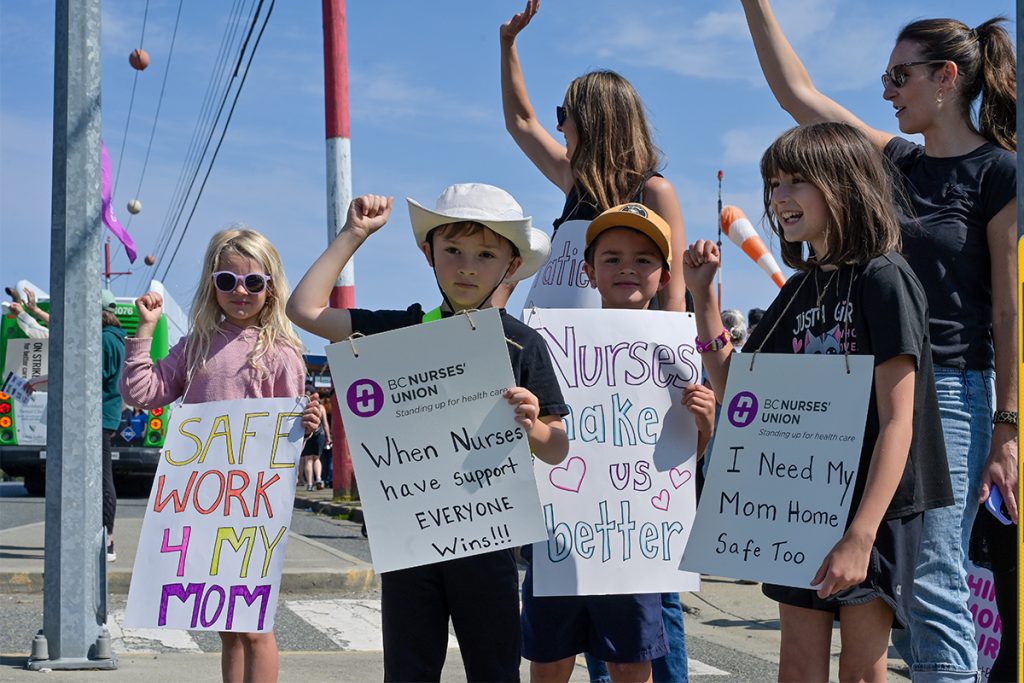
Nurse-to-patient ratios not being met
During the last round of bargaining, the union and government signed a Memorandum of Understanding around minimum nurse-to-patient ratios. The ratios were not part of the last collective agreement.
Gear said the union would still like to see the government implement the agreed to nurse-to-patient ratios, and that a return to the former system where nurses got a premium for working when short staffed was not on the table in this round of negotiations.

“The solution is ratios,” Gear said. “We can get to ratios if these employers come up with a decent retention and recruitment strategy that stops hurting the nurses that you already have.”
Gear would like to see the amount of money spent on agency nurses, which she estimates at “half-a-billion dollars” put towards hiring nurses for the 4,500 to 6,000 vacancies across the province.
“Where we have ratios, nurses are telling us it’s working,” Gear said, citing a reduction in overtime and that patients get the care they need without nurses burning out.
At the Nanaimo hospital, Knudson said what is happening is that the units that are designated to meet the nurse-to-patient ratios are being staffed, but then management is redeploying nurses from those units to others that are critically short staffed, leaving the original unit below the ratio in practice, if not on paper.
“What we need is the government to move faster on implementing ratios in those other units,” Knudson said.
Nurses ‘don’t trust the trust’ president says

One of the sticking points for some nurses in the rejected agreement was a shift from a benefits plan that requires the employer to pay for all benefits to a “joint benefits trust,” where the employer contributes a fixed amount with joint decision making with the union.
One of the risks to a joint benefits trust is that if funding for the trust runs low, coverage could be cut or contributions would have to be increased.
A BC Nurses’ Union webpage also said benefits could be impacted by inflation and spikes in benefit usage.
Speaking with reporters in Nanaimo, Gear acknowledged that some nurses are skeptical that the government and employer will maintain benefits at the same level as the previous defined benefits model.
“They don’t trust the trust,” Gear said, adding that the union bargaining team worked with lawyers and actuaries who analyzed the benefits trust model in the rejected agreement and that the risks were mitigated.
“I don’t blame nurses that they don’t trust [it],” Gear said. “That is definitely a sticking point for some.”
Former Alberta NDP cabinet minister calls on B.C. government to invest in health care

Representatives from nurses’ unions across Canada were on the picket line in Nanaimo.
Daneille Larivee, vice president of the United Nurses of Alberta, was there representing the Canadian Federation of Nurses Unions.
Larivee, a public health nurse, was elected to the Alberta Legislature as an NDP MLA in 2015 and served as the Alberta Minister of Children’s Services between 2017 and 2019.
“There are a lot of priorities to balance when you are looking at a budget, but that is what it’s about: balancing priorities,” she told the crowd of striking nurses. “We are all here to make sure that [B.C. Premier David] Eby and his NDP government understand that you need to be that priority, that your patients need to be that priority and that they have to find the money to do that.”
“Because surely to God, if they can find money for FIFA, they can find money for health care.”
There were also representatives from the Ontario Nurses Association, the Hospital Employees Union and the Health Sciences Association of BC, which includes some nurses who are on strike.
Sarah Kooner, president of the Health Sciences Association, told nurses that they were “fighting for the integrity of public health in this province.”
“Until all of you are not going home burnt out, until none of you are being injured on the job, until all of our patients and clients confidently say that the health-care system here in the province is truly thriving, we will keep fighting,” she said.
Editor’s note, July 14, 2026: Mick Sweetman’s partner works as a nurse in Nanaimo. She was not interviewed for this story but this detail is being shared for transparency.
What did you think of this story?
Your feedback after we publish a story helps ensure we're always improving our reporting to better serve you